Looking west from West Morrell 01, Lolo National Forest, Montana. The real skyline, 14.0 degrees tall, from the U.S. Geological Survey’s elevation map; drawn taller to read on a phone.
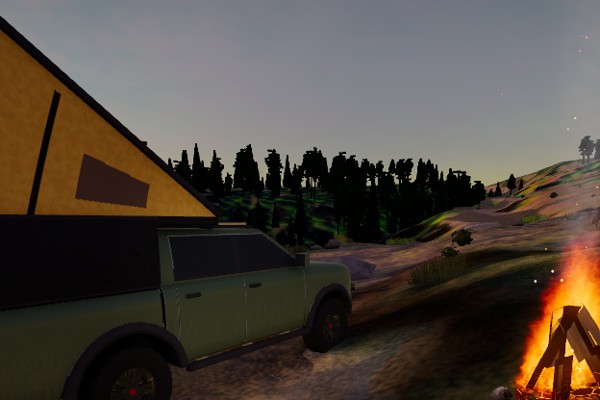
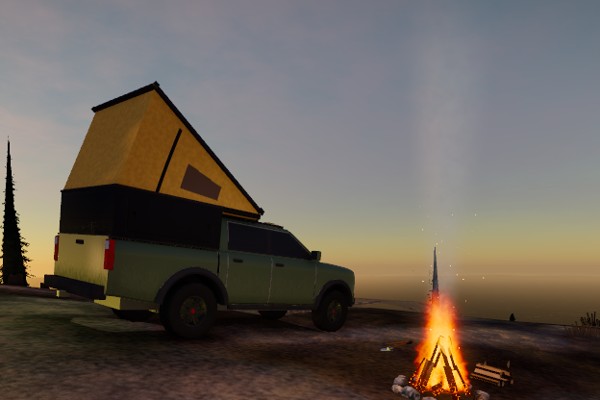
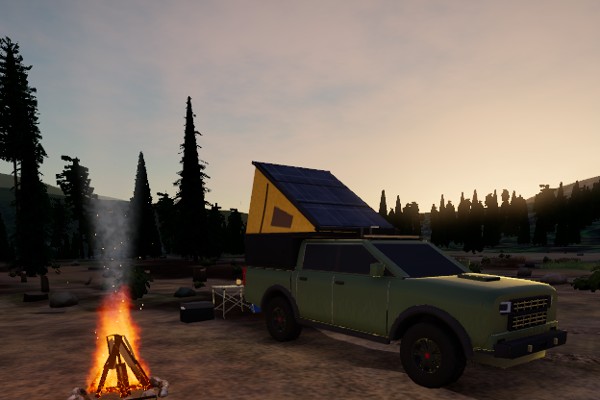
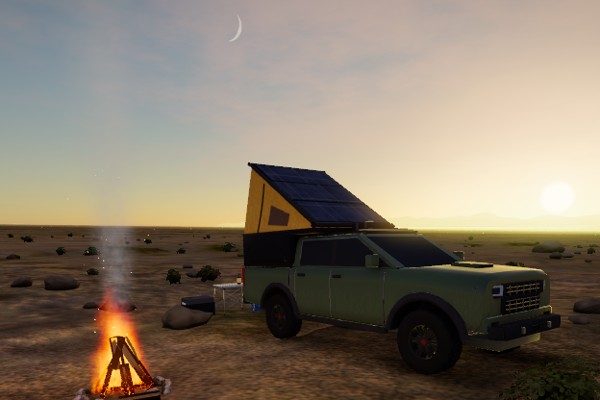
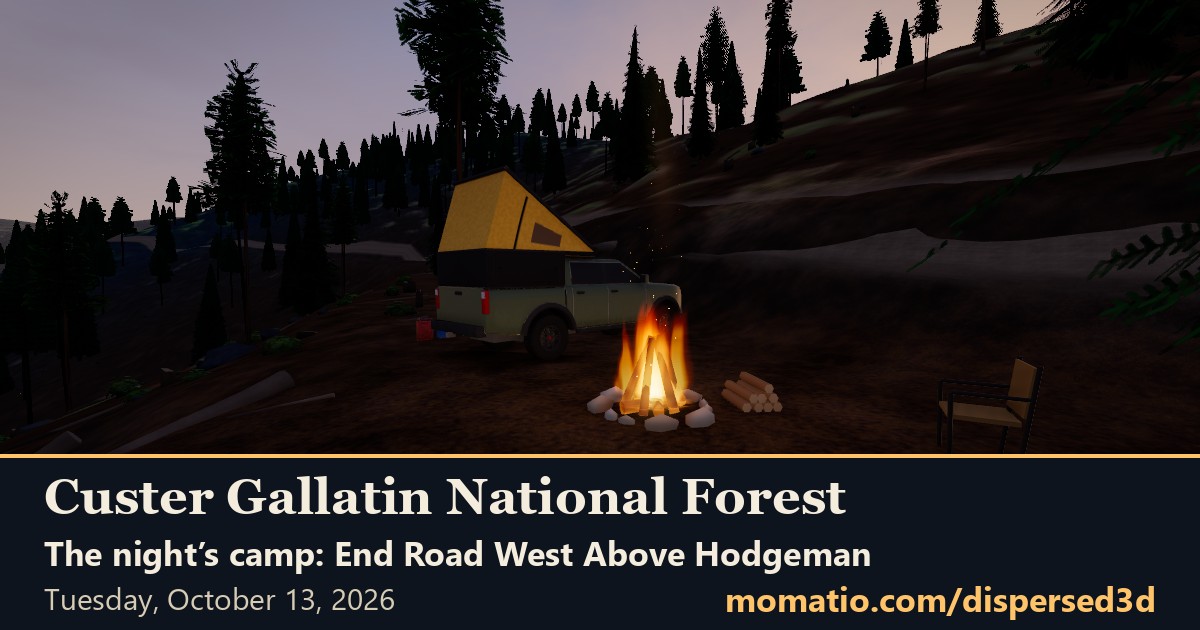
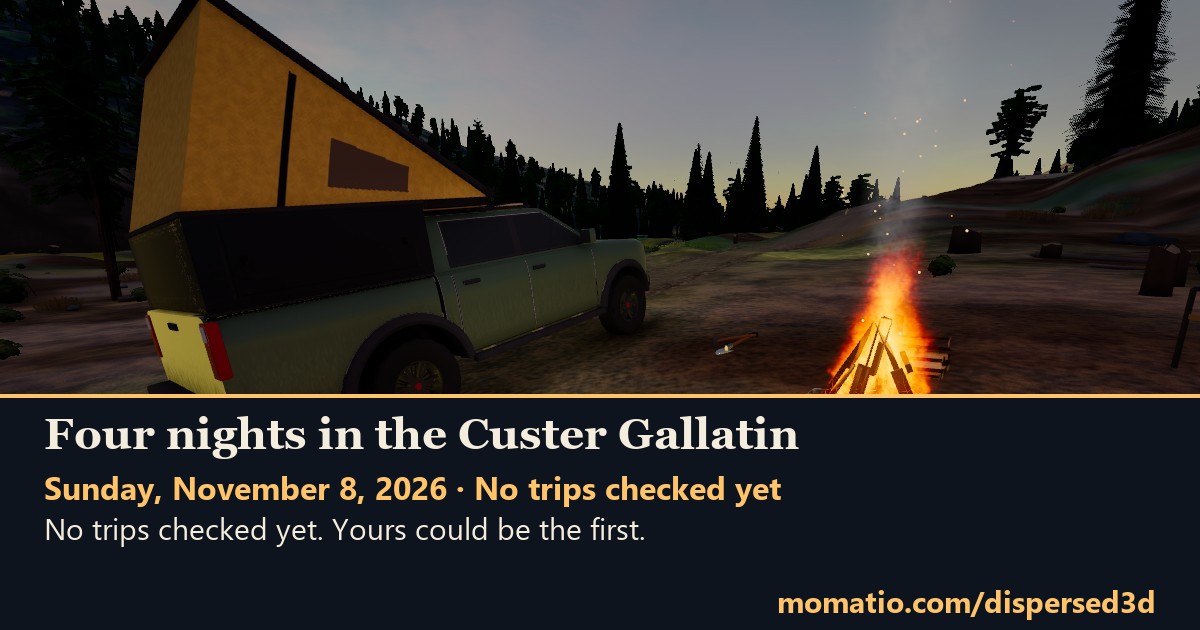
Pictures: each place’s camp for the day, as the game draws it just before sunset; a game view. Skylines: one camp’s real west skyline in each place, all four drawn to one scale, so the desert is low and the forests are tall.
22 real camps
Named from the public record. Each camp card says what the record says about cost, season, stay limit, rules and water, and says so plainly where it says nothing.
The U.S. Geological Survey’s lidar elevation map, about 1 meter close to the camps, under the USGS aerial photograph, which sets the color of the ground.
Looking west from Langohr, Custer Gallatin National Forest, Montana. The real skyline, 11.2 degrees tall, from the U.S. Geological Survey’s elevation map; drawn taller to read on a phone.
Choose parts by kind, watch the numbers change by the game’s own arithmetic, copy a link that is your build, and film it. It stores and uploads nothing.
Looking west from Mono Creek Campground, Beaverhead-Deerlodge National Forest, Montana. The real skyline, 9.8 degrees tall, from the U.S. Geological Survey’s elevation map; drawn taller to read on a phone.
What is overhead and what the forecast says, for your camp and your night.
Tonight’s real sky
The Sun, the Moon with its real phase and position, the stars of the Yale Bright Star Catalogue, and the Milky Way where the galactic plane really is.
What is new tonight
Each night card says when the Moon rises or sets, tonight’s low from the Weather Service, and the first bright star to look for.
Where will the Moon clear the ridge?
On the right nights you mark your guess on the skyline, and at the real minute the game tells you how many degrees off you were.
The space station
The game works out its passes from the published orbit, says when one crosses your camp, and can wake you for it.
The Weather Service forecast
The hourly forecast sets the night: rain at camp, the low, the wind and the dew point. The minutes each chore takes are the game’s guess, and the card says so.
Real fire rules
Where an agency posts a fire restriction for a camp, the cards quote its own words and the day it was read. The game is not permission, and it says that too.
Smoke from above
On a day a NOAA analyst drew smoke over a forest, the sky turns hazy and warm. The map sees smoke from above, so the game does not claim to know how much reached the ground.
AIs play too
The same trip, played by an AI that reads each turn, with every move written down.
The picture the game makes for the leaderboard: a camp at dusk, drawn by the game. A game view.
Your AI takes the seat
Press Have your Grok Bot play, paste one message into your Grok Bot, and it plays while you watch.
Looking west from Scaddan Wash Camping Area, near Quartzsite, Arizona. The real skyline, 2.0 degrees tall, from the U.S. Geological Survey’s elevation map; drawn taller to read on a phone.
The end cards have a link to tell a camp’s record what you found.
Pictures both ways
The camp pictures on davelalande.com’s camp pages come from this game.
The logbook
Every release of the live game, newest first: 87 since October 1. This list is read from the public changelog each time the game is built.
12 on Oct 23
Oct 1Oct 15Nov 1Nov 12
Releases a day, read from the public changelog.
Nov 12, 8:17 AM
Pack the truck before you leave
Pack the truck. Before the four nights start, one screen asks what goes in the truck: the roof shower tank, filled; the hand-wash jug and soap; the water filter; the camp stove and a full canister; a headlamp; the portable battery and panels; and traction boards.
All the notes for this release
Pack the truck. Before the four nights start, one screen asks what goes in the truck: the roof shower tank, filled; the hand-wash jug and soap; the water filter; the camp stove and a full canister; a headlamp; the portable battery and panels; and traction boards. Firewood shows up only where a camp's own record says wood is scarce. Tick what you'd bring, or tap "Take it all." Loading takes no game time, and the gas, the drinking water, the food and the tent are always aboard.
Whatever stays home turns up once, kindly, the first time you'd reach for it. The trip card then says whether you had everything you reached for. Nothing is marked wrong.
AI players pack too. The game's state now says what's aboard, and one new page tool loads the truck. Older challenges and checked runs play exactly as before.
Pick a forest on a map. The title screen now shows a small map of the forests you can visit, with a pin on each, so you can choose where to go by looking at where it is.
The weekly challenge follows the season. From November to April the featured challenge is a warm desert trip, and Montana is featured only from May to October.
Honest limits: the town run still sells only food, so anything left home stays home for the trip.
Nov 11, 7:44 AM
The short loop holds still, and Beat the bot counts your days
The short walking loop is the same on every device. The loop the game lays out from camp used to depend on how much fine detail had loaded on your screen when it was planned.
All the notes for this release
The short walking loop is the same on every device. The loop the game lays out from camp used to depend on how much fine detail had loaded on your screen when it was planned. A phone and a computer could show different loops from the same camp, and the summit named at the turnaround could change between visits. The loop is now chosen from the same ground map on every device and every visit, and it still never climbs more than 30 percent on the ground you see. Nothing about the walk's length rules or the "this path is the game's, not a mapped trail" note changed.
Beat the bot counts your days in a row (/beat/). Finish all seven decisions and the end says "Day one", then "2 days in a row", "3 days in a row" and so on, and your share line carries it from day two. It counts days you played, never how often you agreed with the AI.
A saved trip can only be added to from the browser that started it. A new trip now gets a private key that stays in your browser. The trip code you share still opens the replay for anyone, but only your browser can keep saving to the trip. Trips started before this update work as they did.
Honest limits: the days-in-a-row count lives in your browser, so clearing your browser's storage or switching devices starts it over. If you open a trip you started on another device, you can watch it but not keep saving to it there.
Nov 9, 9:25 PM
Three daily games, and "Ask your AI" on a finished trip
Beat the bot (new page, /beat/). Seven real decisions a day, taken from checked AI runs.
All the notes for this release
Beat the bot (new page, /beat/). Seven real decisions a day, taken from checked AI runs. You see the place, the clock, the gas, water and light line, and the moves the game offered. You pick, then see what the AI picked and its reason. Your pick and the AI's are shown the same size, and neither is marked "right"; a "Watch this moment" link replays that spot in the game.
Name that forest (new page, /skyline/). A daily quiz: a drawing of a skyline as seen from camp, and you name the place (four choices: three Montana national forests and Quartzsite, Arizona, which is BLM land). The skylines are drawn with the game's own calculation from the same ground data, so the answer is the one the game itself would show.
When does the sun leave this camp? (new page, /puzzle/). A 30-second daily puzzle. You guess the minute the ridge takes the sun away from a real camp, and see how close you were. The answers come from the game's own ridge calculation, not a second guess. Calculations only count the ridge on our map, so a real camp can differ by a few minutes.
Ask your AI about this forest. The trip-ended card now has three plain links (Claude, ChatGPT, Perplexity) with a ready question about planning four nights in that forest with one town run, plus a copy box if you use another assistant. Nothing is sent from our page, and only the forest's name is in the link; some assistants run the question as soon as it opens. To use our camp records, add davelalande.com/mcp as a connector in your assistant's settings. Without it, your assistant answers from the web.
Montana stay limits say the real rule. Montana national forests now show the Forest Service order (16 days in a row on one site) instead of the general 14-day rule, including in the "stay limit" tap-pop-up. The game counts your nights in a row against the 16 and names the order's 32-day yearly limit without counting it.
Footer: the three daily games (the sun puzzle, Name that forest and Beat the bot) now have their own sentence.
Honest limits: the three daily pages use one set of days for everybody (no accounts, no scores kept on our side). Beat the bot's seven decisions come from the checked runs we have, so the pool is small and will repeat. Beat the bot leaves out any moment where an AI calls a camp free that the Forest Service lists as a paid campsite.
Older releases are folded by month to keep the page short.
November 2026: 9 more releases, 12 in all
Nov 9, 12:31 PM
Your own AI makes the Call
Your AI makes the Call. Pick a real moment from a checked AI run (the place, the clock, the gas, water and light line, and the moves the game offered) and let your own assistant choose. The page plays the replay to that moment, holds, and shows "Your Claude called: ..." beside what the checked AI did there, with its own reason. They're the same size, and neither is marked right. It works with Claude, ChatGPT, Grok, Gemini, Perplexity, Copilot or any other assistant.
The leaderboard shows the way in. A short note under the board links a ready-made Call from a checked run, and says your AI can also be handed the controls with one prompt.
Page tools for AI players. With ?ai=1, in a browser that offers page tools (today, Chrome with its WebMCP test setting turned on), an assistant gets exactly three tools: read the game's state, read the menu, and make a move. A move through a tool is the same move as one made from a prompt, with the same rules, the same replay and the same score. Without page tools nothing changes.
Nov 8, 9:09 AM
Two camps cost money, and the wait shows where you are going
Two camps were called free, and they are not. By the Forest Service's own pages, one of Custer Gallatin's camps is a reservation-only group site at $185 a night, and Mono Creek is $15 a night plus $5 for each extra vehicle. The camp cards now say so, with where the price comes from. Custer Gallatin's first goal is now Moser Road 6212 G15.
Tonight's camp is one you can win. From November 10, the game's pick for the night skips the few camps where nothing near the pad can be leveled, or where the camp's own ridge takes the sun within half an hour of a first arrival. Nights you have already played keep the camp they had.
While the game loads, it shows where you are going. On a first night, the wait names your camp and today's real sunset, says what it is doing ("Loading the real ground", then "Building the view"), and shows a game view of the camp. On a slow connection it says so instead of sitting on a number.
The back gesture closes the card. On a phone, going back with a card, Help or the drawer open now closes it and keeps you in the game.
The trip card counts every mile. The trip card, its picture and the copied text now say how far you really drove, the run to town included. The night notes say when they leave the town run out.
"Sit out the afternoon" says what it costs: a gallon of water, on the button and the Stay card.
An empty tank says so. The rig won't pretend to start a drive on an empty tank, and after a reload the title says plainly that the trip ended and the rig wasn't saved.
Continue after a reload in the middle of a drive now says the drive stopped and to pick it again in Drive.
The Features page has a new look. It runs from late afternoon to night as you scroll, with a thin light-left line on top, the four places as game pictures with their real skylines drawn to one scale, the features as short tiles, and the changelog as a logbook with a chart of releases a day: Features and changes.
Crystal Hill's own rules now reach the live game. Last night's notes said Crystal Hill is on Kofa National Wildlife Refuge and that gathering wood there brings a small pile, but the live game was still reading the camp's older record until this morning. It now has the refuge as the land manager, with the refuge's own camping, fire and stay rules.
The map names the camp you are going to. On a phone, a long camp name that fits nowhere with its grid square is tried without it, so the goal is never left as a bare dot.
Smaller things: a washboard tip no longer lands on top of a later tap, and the changelog's month fold now says how many releases the month had in all, not only the ones folded away.
Nov 7, 9:05 PM
A first night that starts itself, and a trip that survives a reload
A link to a forest now opens your first night. Someone new who follows a link lands on the road to a real camp, with one sentence that says what this is, where it is, and when the sun goes down there today. People who've played before still get their own trip.
A reload keeps your whole trip. Continue used to hand back a full food box, forget your garbage, and lose count of your nights at a camp. Now all of that comes back, along with your morning, and a reload can't give you a second town run. A finished trip's card stays too: See your last trip's card.
Set up once, not every morning. At a camp you're holding, the hand-wash station stays up while you're there. The stove goes on the tailgate to cook and back in the bed after. A tent left holding a site stays up and costs no minutes, and the camp card says the site is held.
A morning isn't one tap anymore. If you close the morning card, the camp card's Back to this morning brings back its choices, like the town run and Stay today. A stove left out now gets its own button on the way to town.
Two more dinners on the coals: fish fried on a flat rock, and bannock bread, next to the foil packet. Each has its steps in Camp Cook, with a first-timer's tip: use a dry rock from up the bank, never one from the creek.
The desert plays by the desert's rules. Where water is the limit, a fire that burned down and felt cold still counts as put out for your trip, and you can light one on short water if you stay with it until it burns down. A posted fire rule still comes first.
A camp's own rules change what you can do. Crystal Hill is on Kofa National Wildlife Refuge, and the refuge says wood is very scarce and asks you to bring your own, so gathering there brings a small pile. The Quartzsite world's first goal is now Scaddan Wash.
The morning card tells the truth. It could say "You set up in the dark" after a camp made in daylight, and "level" after a night on a slope. It now goes by when you really made camp, and says nothing about level it hasn't measured.
Send this night. One button shares your film and a link to your camp. The page your friend opens says plainly when its picture is another camp or another day.
Build yours. The rig pages let you pick parts by kind, see what the game's numbers do, and film your build in 20 seconds. If a phone is too busy to finish the film, it says so instead of handing you a short one.
What would you do? A checked AI run can stop on one real decision and ask you first, then show what it did and what the trip needed.
Hear its reasons. On a Watch page, one tap and your own device reads the AI's reasons out loud. It's your device's voice, and the page says so.
Films tell the truth about numbers. A caption could cut a decimal apart, so "1.7 gallons" read "7 gallons". That's fixed, and the affected films have been made again.
A page for everything in the game.Features and changes lists what the game does and every release so far. Open it from Help, under What's new.
Smaller things: a sideways phone keeps more of the road in view, the level card's numbers and verdict show without scrolling on a phone, a long web address can't push a card wider than the screen, and turning in just before sunrise sleeps to that sunrise instead of a whole extra day.
Nov 5, 9:39 PM
How much light is left at your camp
"Light left" now leads with your camp's own minutes. At a camp with a ridge to the west, the line says something like: 36 min of light left at this camp, the sun leaves it at 5:30 PM behind its ridge, and sunset is at 5:42 PM.
After sunset is not after dark. A drive that ends past sunset now says "after sunset", and "in the dark" before sunrise, in the drive line, the arrival and the town run.
The level card says when your camp counts as made: when you press its button, after the leveling minutes, not when you pull in. When the line is close, it says how many minutes you have.
Steep camps are named before you drive there. A camp whose pad the game's map can't level says so on its Drive line.
"Wait until an hour before sunset" is on the menu from the morning, so a long desert day isn't one short wait after another. A wait for a set time now ends on that minute.
An AI's reply that matches nothing on the menu now hears so, with the two closest lines named. A number and words that disagree get both named, and nothing is played.
Smaller things: the dead-out card's line says it has 4 steps and which one takes the tent down, a walk to the water with a full jug says it adds no water, and the night card's rain buttons change when the forecast hour turns dry.
Nov 5, 5:14 PM
Your film has sound now
The films you make now carry the game's sound: the road, the camp, the rain, and the crackle of a burning fire when you're watching a replay. It needs the Sound switch on and a browser that can record sound. If it can't, the film still gets made, silent, and the game says so.
The first minutes on a phone are clearer. The coach's tip no longer sits on top of the Drive it button, and it now says what to tap: Drive it to go to your camp, and a Camp button appears when you get there.
AI players can now see the light. Every drive line tells them about how long it takes, when they'd arrive, and whether there's light left at that camp. When a camp is made after its dark line, the reply says why.
An AI can name its pick. On the game page, it can answer with the first words of a menu line, not only the number. A pick that could mean two lines gets refused, never guessed.
Nov 5, 10:21 AM
Be on your pad while you can still see
Camp made before dark. Each camp has its own dark line: the minute the sun goes behind its west ridge, or sunset where no ridge takes it early. Make a camp after that and setting up takes half again as long (the game's guess), and the trip card has a new row, Camp made before dark, every night
Walk the pad before you go. One more line when you leave a camp, 3 minutes. About one camp in three, the game leaves something small there, like a tent stake or a twist tie, and says plainly that the game put it there. Leave No Trace says to inspect your campsite before you leave
Fire rules now go by the forest's own day. After 5 PM in Montana the card could read tomorrow's date. An order that has ended leaves the card, and a food order doesn't count before it starts
When the hot shower or dinner on the coals isn't offered, the game now says why
Been here for real? The end cards have a new link to tell a camp's record what you found
Nov 4, 2:45 PM
What is new tonight
Each night card now has a row that says what is new tonight. The first night it is called Tonight; after that it is Since last night: when the Moon rises or sets and how many minutes later or earlier than last night, whether it is thinner or fuller, tonight's low from the Weather Service, and the first bright star to look for, with its time
The short loop on foot now names a different real thing each time you walk it from the same camp: the summit you can see from the turnaround (from the GNIS names), then the camp's creek by its USGS gauge reading, then a fire perimeter the loop goes into (from NIFC's record). A camp with only one of these says it every time, as before
The morning page warns you once when there is less water in the jug than the nights left will take, in the game's own numbers: "the jug has 3.6 gallons in it, and the 3 nights left take 4.2 gallons"
The trip card's Left it better row now says where to look: the walk on foot around camp is where you see litter at a fire ring
"The sun clears the ridge" is said as something that will happen until the clock gets there, and as done after
When a weak connection drops the very first download, the game quietly asks once more instead of stopping on "This world could not be loaded"
Nov 3, 7:24 AM
In the rain you get inside
When the Weather Service's hourly forecast says it is raining at your camp, the camp card says so, with the chance and about when it stops. Cooking, dishes and a fire outside still work, but you are standing in it. The card offers the dry ways: Wait out the rain in the cab (or inside the van) until the forecast's first dry hour, up to 2 hours; Get in the tent for the rain once the tent is up (take what you need and go potty first); Eat something that needs no stove; and, once you're inside with the satellite dish up and sky over it, Watch a show on Starlink, which draws from the batteries like the dish does
The trip card gains a row on a trip that saw rain at camp: Got in out of the rain. It is checked when nothing was cooked, washed up or lit outside while it rained. The van's galley is inside, so it cooks in any weather. Rain that falls only while you sleep doesn't count
Camp parking spots now keep off creeks. The aerial photo misses narrow creeks, so the game also reads the USGS creek lines: a spot within 40 feet of a creek is refused when other ground will do, and spots 200 feet away, as Leave No Trace says, are preferred. Morrell Creek's spot in the Lolo moved off the creek bed
On a phone, the first-night card has Send this night: one button hands your 10-second film and your meet-me link to your phone's share sheet together, so a friend can play the same first night. Your phone does the sending; the game sends nothing itself
On the rig drawings, tapping an add-on part (the winch, the fridge, the solar panels and so on) shows one quiet line saying it can carry a sponsor, with a link to the sponsor page. A rig's own factory parts never get one
The 10-second film's caption puts the date on its own line when the forest's name is long, so the year is no longer cut off
The friend's line on the radio no longer ends a sentence with two periods
Nov 1, 4:51 PM
Dinner on the coals, and where will the Moon clear the ridge?
After 5 PM, once your campfire has burned down to coals, the night card offers a second Cook: Dinner on the coals. Camp Cook plays a foil packet of potatoes, onion, smoked sausage and butter, about 20 minutes in the coals and turned once. You see a ring of stones, glowing coals, the foil folding shut, and tongs turning the packet
The packet's food box uses U.S. Department of Agriculture figures for each food (sausage, potatoes, onion, butter), with the amounts marked as estimates. It is the game's own recipe until Dave adds his own camp dinners
On a night when the Moon (or, on a moonless night, a bright planet) will rise over your camp's real ridge, the evening card asks Where will the Moon clear the ridge? Mark your guess on the skyline, which is drawn from the USGS elevation map. At the real minute the game says how many degrees off you were. Sleep through it and the morning card still tells you. The 10-second film's caption carries it too: "Guessed the Moon within 6 degrees"
Meet me at my camp: the first-night card says how many minutes before the sun left your camp's ridge you made camp. Copy the link and a friend sees your camp's picture with one button to play the same first night; their card then compares, in one line, how early each of you made camp. The numbers ride in the link itself, so nothing is sent anywhere
The camp pictures on the share pages and on davelalande.com's camp pages were re-taken without the rig's sponsor panel
October 2026: 75 releases
Oct 31, 9:05 PM
The rig tour holds still on a phone
The rig page's take-apart tour no longer scrolls the page on a phone, while it plays or when you drag through it
The first-night card now says exactly what stays on your device: nothing about the picture or the film is sent anywhere
Oct 31, 11:44 AM
Your night in 10 seconds
The first-night card now shows a real picture of your camp at dusk, taken in the game, instead of a drawn card
Make the 10-second film plays your camp's real sky from sunset into the night in about 10 seconds: about 4 seconds from sunset to the end of twilight, then 6 seconds of night, following the Moon when it is up. It is made in your own browser and saved to your device; nothing is uploaded. The film is brightened like a phone's night photo, and it says so. The ordinary morning card offers it too
A shared first-night link now opens on the forest's page with a picture and one button, Play your first night, so it shows properly when pasted into a message
After a first night, Stay another night carries on in the ordinary game from the same camp, the way Continue does
Camp pages on davelalande.com that fall inside a game forest have a Spend your first night here link. The first night then points you at that camp, and its card links back to the camp's own record
On a first visit the title shows one way in, Your first night, and folds Four nights and the challenge under More ways to play. Coming back, you see all three
The rig page has a take-apart tour: buttons for Power, Water and Gas pull each system out with gauges from the game's own numbers, a sky-cover slider shows what clouds do to the solar panels, and a 30-second tour runs by itself
Oct 29, 2:06 PM
Your first night
A third button on the title, Your first night, is a gentle way in for anyone who has never camped. You start at the forest's town junction with full tanks, about 90 minutes before that forest's real sunset
A small coach card walks you through the evening one step at a time: find a camp, level the rig, set up the tent (or put the van's awning out), and light the fire (or, where the posted rule says no fires, skip it). Each step says why it matters
On your first visit, Your first night is the button the title points you to. Continue brings a first night back right where you left it
In the morning, a first-night card shows what you got done before dark, with a picture to save or share and a link that opens straight into Your first night (add ?first=1 to the game's address)
It's free play with no score, and it never mixes with a challenge
Oct 28, 11:07 AM
Each camp's real record, and something new every night
The morning card links the camp's own page on davelalande.com, with a reminder to check closures and fire rules with the forest (or the BLM office) before you go
When a trip ends, its card names the camp you slept at most: what its record says it costs, how long you may stay (the record's own limit, or the general 14-day rule on national forest and BLM land, said as the general rule), and the same link
Each night's card says one thing that is new tonight: the brightest planet up after dark, the first bright star to rise, the Weather Service's wind and low, or the nearest creek gauge against a day earlier. Each line says where it comes from, and no two nights in a row say the same kind of thing
Oct 28, 5:49 AM
Crawl the rough roads, read the river before the ford, bring your gear in before the wind
On rocky and rutted roads a new Crawl button (beside Air down) slows the rig to spare its tires and parts; rushing a rough road makes a flat or a broken part more likely. In sand and mud, keeping your speed up still matters
A trip that drives rough road gets a new row on its card: Took the rough roads slow
Airing down still helps a little on rough roads, but it no longer earns a row or a field note
At a creek ford the game reads the real USGS river gauge. When the water stands above where it was a day earlier, walk the ford first or camp and cross in the morning (Read the gauge before the ford)
A fire lit where a fire ban is posted no longer counts as put out right, however well it was drowned
The wind in the Weather Service's hourly forecast now matters at camp: bring the van's awning in by 20 mph, and take down the Starlink dish and the portable panels by 30 mph (a tent left alone to hold a site tears at 30 mph too). Gear left out blows over and is gone for the rest of the trip (Took your gear in before the wind)
The Tacoma's camp stove is camp kit now: set it up outside before you cook, and pack it cool with the fuel capped before you drive on
The Tacoma carries a 100 Ah portable battery and two portable panels in the cab. Set them out in a sunny spot; the dish draws on the portable battery first, which spares the house batteries for the fridge
The van fills its fresh tank with town water on the one run to town (Filled the fresh tank with town water); creek water is for washing
Filtering water says up front when the jug is already full, and Pack up camp names everything still out, the stove and the portable kit included
Oct 27, 4:20 PM
Your rig's fridge, batteries and traction boards
The camp's cooler is now the rig's 12 V fridge/freezer, and it runs on the rig's batteries
One battery gauge on the camp card: the fridge and the Starlink dish draw from it, and the solar panels charge it by day, less in shade and under cloud. Let it run flat and the next morning a day of food is spoiled
Stuck in mud or sand, the traction boards take three steps: get them off the rack, drive out on them, pick them up. Leave them behind and they are gone for the rest of the trip
Each rig camps its own way: the Tacoma has a headlamp, a camp stove outside, a cathole and dishes washed outside; the van's cabin lights and induction cooktop run on its batteries, and its toilet and gray tank are emptied at a dump station
A trip has one run to town and back; heading for town at the end still ends the trip
The camp table, lantern and fridge come down when you turn in, even with the dish left up for the night
Starting a new Self Drive while the rig is still rolling brings the speed buttons and Stop back to the windshield
Oct 25, 9:40 PM
Make a video of any trip, to post on X
Any replay can now make a video of itself, right in your browser: about a minute to make, about 55 seconds long, an MP4 you save and post on X
It opens with a card naming the forest, the length of the trip and the AI that played it, and ends with the web address so viewers can play it themselves
In between are the trip's big moments (the first drive, scouting a camp on foot, making camp, the fire, the night, the morning), each with the game's clock and the AI's own reason
Press Make a video to post on a trip's replay; your Grok Bot's end-of-trip question offers it too. After saving, Copy the words for X gives a ready post
Works in Chrome and Edge on a computer, and is made upright on a phone held upright
Oct 25, 9:18 PM
Your Grok Bot asks three things at the end of a trip
When the trip is over, your Grok Bot asks one question with three boxes: put the trip on the leaderboard, send you the replay, send you the turn-by-turn log
It does only what you tick, and the page it reads gives it a link for each, so nothing needs the game's tab
Any finished trip can now be replayed from its trip code, in the same Watch this run player as the leaderboard's runs; it says plainly that the trip has not been checked for the leaderboard
Oct 25, 9:07 PM
One press to your Grok Bot, from anywhere in the game
Play with your Grok Bot, under More (in the drawer on a phone), now goes straight into this week's challenge in a new tab: the trip is started, your Grok Bot's card is open and its message is copied
The card of example pictures and the challenge's title page no longer stand in between
Where a browser will not copy without a tap (an iPhone), the green Copy button is the one tap left
The game you were playing stays as it was in its own tab
Oct 25, 5:36 PM
Your Grok Bot keeps its seat
If the game's tab is hidden behind your Grok chat, your Grok Bot's seat now stays open instead of closing after 10 minutes
Your Grok Bot is told the game is paused and asks you to bring it back; its move is saved and plays the moment the game is on screen
The hidden tab's title says your Grok Bot is waiting, with the trip code, so you can find the right tab
Opening your trip again later on the same device picks the seat back up by itself, so you do not press Have your Grok Bot play again
Oct 25, 3:20 PM
Charred logs and glowing coals
Where the fire works the logs, the wood turns black and the char splits into small blocks that glow orange in the cracks
The coals are a jumble of separate lumps, each at its own heat: orange-yellow where hot, deep red where cooler, cooling as the fire dies
Once the flames are gone, the inside of a steel fire ring dims instead of glowing brighter
Oct 25, 2:49 PM
A real campfire
The campfire's flames are a real fire: simulated once on our own computer with Blender's fire solver and filmed, then played back in the game
The flames have soft orange-yellow bodies, red edges and a bright core, and they flare up when you add a log
On a phone the fire uses about 2 MB of graphics memory, and only once you light it
Oct 25, 2:01 PM
A real cab, and one press for your Grok Bot
The inside of the truck and the van is rebuilt: molded plastic pillars and doors with a satin finish, a grained and dusty dash, chrome door handles, silver vent rings and stitched seats, lit by the daylight through the windows
The view from the driver's seat is the same as before; only the finish changed
On a phone the new cab uses about 3 MB of graphics memory
On this week's challenge page, the first button is Have your Grok Bot play: one press starts the trip, opens the Grok Bot's card and copies its message, and the button turns green and says Copied
With a saved game, the start button says New game, and says the saved game is replaced once you drive or walk in the new one
Oct 25, 1:58 AM
Crisp rig drawings
The pulled-apart drawings of the Tacoma and the van have clean lines and big part names, and on a phone the parts are numbered with a list underneath
The drawings no longer have the color and hand-drawn wobble controls
Oct 24, 11:08 PM
The van talks like a van
In the van, the game says water tank, awning and "into the van", and you leave a marker to hold a site; the Tacoma's words are unchanged
Driving away from a camp you made now warns that it closes the camp, and to leave something to hold the site first
Distances are rounded, and the forecast line says the day it was issued
The van has a bed inside instead of a tent: at camp you put the awning out and set the leveling blocks, about 3 minutes each way
The van carries 24.5 gallons of diesel and 30 gallons of fresh water, and showers in its wet bath
The van will not take the roughest roads, the ones the record calls 4WD or keeps at the lowest maintenance level, and it says why
A ride now eases in instead of jumping straight to full speed
The trip code has "Copy it" and "Save it as a file" instead of an email link
Oct 24, 6:06 PM
The desert week, a new start picture, and no brand names
This week's four-night trip is near Quartzsite, Arizona, on Bureau of Land Management land: the Montana forests had a cold, wet forecast for Monday, and we only send you camping in spring, summer and fall weather
On that trip the town pump fills 10 gallons, so the drive home and the back half of the week matter
The start picture is shot from the truck's other side, with the fire beside its sign instead of in front of it, on a computer and on a phone
The overland gear on your rig is named by what it is, not by brand: pop-up camper shell, 12 V fridge/freezer, lithium batteries, battery monitor
The start screen shows your rig: a picture of the truck with its overland gear pulled apart and named, and See your rig opens the drawing you can turn
On the start screen the tent pick now reads Your tent
Oct 24, 12:06 AM
Your rig, and an easy way back
Dave's rig is now Your rig, ready for more vehicles later
The drawing has a clear Back to the game button at the top, and your browser's Back button closes the drawing and keeps you in your trip
Oct 23, 10:48 PM
Dave's rig on every trip
Dave's rig, the drawing of his truck and its gear, now opens on a challenge trip too (More, then Dave's rig, while the truck is stopped), not only in free play. The clock waits while it is open
Oct 23, 9:06 PM
The truck drives smoothly
Steering eases in like a wheel and comes back to center when you let go, instead of snapping to a full turn the moment you press a key. At road speed a full turn is gentler, and a quick tap is a small correction
The truck no longer turns while standing still, and backing up steers the way a real truck does
Leaving the road slows you smoothly instead of all at once, and a slope off road no longer drops you to a crawl
Letting go of the gas coasts gently, and the brake is firmer than coasting
On a phone, the stick is proportional: a light push drives slowly
Mouse turns ease out instead of stopping dead
Oct 23, 6:21 PM
Wash your hands at camp
At a made camp, set up the hand-wash station: the 2-gallon jug and the soap go on the camp table. Then Wash your hands appears, about a quart a wash. The station is camp gear, so pack it up before you drive on
A new habit on the trip card: Washed your hands at camp every night. Dave carries this jug and has never gotten sick in the backcountry
The hand-wash jug is its own water, apart from the drinking jug and the roof shower tank, and a town run with water fills it too
Oct 23, 5:55 PM
The hand-wash jug joins Dave's rig
Dave's rig (More, then Dave's rig) now shows the 2-gallon hand-wash jug with its spigot and the soap beside it, under Break out with the other overland add-ons. Dave carries it to wash his hands at camp and has never gotten sick in the backcountry
Oct 23, 4:33 PM
Town fills the roof tank too
When you get water in town, the roof shower tank fills along with the jug, the way Dave does it. The town list's water line shows both
Oct 23, 3:47 PM
The shower has its own water
The hot shower now draws from the 4-gallon tank on the roof rack, 2 gallons a shower, the same as on Dave's rig. Your drinking water stays in the jug, and a trip gets two hot showers before the roof tank is empty
Oct 23, 10:48 AM
REAL says where it comes from, and the road to town
Tap a REAL badge and it says, in one line, which public source that fact comes from, and opens that source's entry on the What is real page
Five words explain themselves on a tap: dead out, dispersed, MVUM, Red Flag Warning and stay limit
Going to town rides the real road out of camp toward the pump for a few seconds, with its miles and gallons. Tap to skip it
The morning card says what you slept on: how far off level the truck sat, and how far away the level spot was
In the desert, a dry wash no longer fills your jug
Oct 23, 7:44 AM
The sun over your ridge, and the creek in real numbers
The morning card says when the sun cleared your camp's own ridge and toward which named summit, and how late that was against a flat horizon's sunrise. The ridge comes from the elevation map and the summit's name from the federal place-name record
Where the USGS has a stream gauge on your camp's creek, the walk to the water, the filter and the dip quote its real flow and height, how far away the gauge is, and how long ago it was read
Oct 23, 6:49 AM
A hot shower, and a walk from every camp
On a sunny afternoon at camp, take a hot shower off the roof tank: 2 gallons and 10 minutes. The game won't let you if the jug couldn't then cover tonight and putting a fire out, and it reminds you to carry the soapy water at least 200 feet from the creek
Filtering water at the creek now fills your jug
Every walk to the same water takes the same minutes, worked out from the distance at a walking pace
Once you've packed the cans and foil out of a fire ring, it stays clean for the rest of your trip
The short loop on foot, once offered only at trailhead camps, is now offered at every camp by day where the ground allows one. The path is the game's, not a mapped trail, and the turnaround names a real summit you can see
The camp dashboard's buttons use the same names as the evening card: Start a fire, Level the rig, Settle in for the night
The tent you leave to hold your site is now a small A-frame tent
The lines about gas name the station the route really goes to
When the forecast on file is out of date, the game says which days it covers instead of saying nothing
The morning reads the same wherever you stand: Morning after night 1 of 4
Oct 23, morning
The rack load rides on your truck
The truck you drive now carries the load from Dave's photos on its cab rack: a tan traction board across the front, then the flat black shower tank, then the camper
The first-visit welcome on a phone fits the screen without scrolling
Oct 23, early morning
A better night at camp
The evening card opens with three big doors: Settle in for the night, Stay up and walk around camp, and Sit by the fire. The rest folds under More tonight
On a night with no fire, whether it's banned or you just didn't light one, you can Sit out under the stars: the lantern on the table, the sky turning, the stars and the space station rising, until you get up or the sky goes gray
Step out of the rig at a camp and the game tells you, once, what you'd notice on foot: how much the ground slopes where the camp sits, by the USGS lidar, and the water nearby and how often it runs
A desert wash is called what it is: water the national map marks as running only part of the year says so on every walk, filter and dip, and in the desert it's a dry wash most days
The morning card has a new line, Water and gas: what tonight and a fire will take from the jug, how far the creek is, how far the gas goes, and how far town is
At some camps somebody left cans and foil in the fire ring. Now you can see them, and Pack out what somebody left clears them away
When another party has the camp you were headed for, you now see it: their rig on the pad, tent up, and somebody gives you a slow wave as you come close
Cook says what you made
Dave's rig opens a little lighter: its drawing loads only when you open it
Oct 23, after midnight
Dave's rig, fixed from his photos
The camper's tent now opens the way Dave's does: hinged at the front, rising at the back over the tailgate
The camper reaches forward over the cab roof. That's what makes the bed long enough for an adult to sleep in
On the cab's rack, front to back: one traction board turned across the rack (Dave stacks the pair), the 4-gallon shower, then the camper
The rear door handles moved to the back edge of the rear doors, where they really are
The winch hidden in the front bumper shows through the lower opening, with its fairlead and hook
The Dometic fridge in the back seat is drawn at its real size
It's a 4WD truck, and now it says so: Drive shifts between 2H, 4 High and 4 Low with the rear locker, and you can watch the front shaft start turning
Oct 22, evening
Dave's rig
Stopped in the forest, More (the drawer on a phone) now has Dave's rig: the maker's own 2020 Tacoma TRD Pro, drawn by hand so you can turn it all the way around
Pop the camper's tent, open its wings and put the sun on its panels to watch the power run to the fridge
Drive it, or shift into 4 Low and lock the rear differential
Break it out two ways: the factory parts from the V6 back to the rear axle, or the overland gear pulled away from the truck, every part named
Later that evening: with the gear broken out, the batteries' label points at the nearer battery from any side, and the sun's ray reaches the panels without crossing the ladder
The game waits while it's open
Oct 22, noon
A cab drawn from a real truck
The inside of the cab is redone from photos of Dave's own Tacoma: a dusty charcoal dash with a defroster grille, the gauge hood and the top of the wheel, the center stack, wide windshield pillars, the headliner with its map lights, and matching doors with armrests and window switches
A folded paper road map and binoculars ride on the passenger seat
Dead ahead the road stays clear, and at night the cab goes dark with the light outside
Save the dawn leaves the cab out of your clip, so the sky stays clear
Oct 22, morning
The run to town
On a four-night trip, Go to town and back opens a list you tick: gas, water, groceries, dump the garbage, and a meal or a coffee, each with its own minutes
Before you leave, it adds up the drive and the errands and says when you'd be back, and warns you in amber if that's after dark
You start with three days of food. Each night uses one, and groceries fill it back up
Every night makes a bag of garbage, and town is the only place it goes. The trip card has a new row: Packed out your garbage
Gravel and dirt roads burn more gas than pavement, so crawling to a far camp costs you
On a phone, the pulled-up drawer fits on the screen again with nothing to scroll
Starting over is clearer: a new game now opens with "A fresh start" instead of "Welcome back", and Title in the middle of a game offers Start a new game. Your last game waits under Continue
Oct 22, overnight
Before you settle in
While you're stopped, one line under the clock shows the trip so far: which night of four, and the gas and water left
Settling in before the tent is up and the food is stowed now asks first, once a night
The night card opens on Before you settle in and the chores, with the camp's record and rules below
Help opens on a five-line Quick start in the game's own button names
After four nights, one picture of your trip card with the gas and water left, to save or share
Where a forest posts a real food order, the morning card names it
The level card is called Level the rig, the morning says Morning after night 1 of 4, and the fourth morning warns before packing up ends the trip
Oct 21, afternoon
The inside of the cab
From the driver's seat you now sit inside the truck: a dash with a lip, thin windshield pillars, doors with a window ledge and an armrest, and the roof edge
Look out the passenger window and you see the window, the door and the dash, the way you would in a real truck, instead of a flat edge of hood
Dead ahead the view is unchanged, and at dusk the cab goes dark with the light outside
Oct 21, early morning
A driver's seat that feels like one
The hood stays bolted to the truck and level, whichever way you look
From the driver's seat you can turn your head to either side window and nod a little, but not stare at the ground; on foot you can still look anywhere, all the way around and down at your feet
Moving the mouse to a button or a panel no longer swings the view on the way there: the view turns when the cursor rests near an edge
Oct 20, evening
A clear windshield while you drive, and map squares like a paper map
Enjoy the ride is now the game's way for everyone: once you're rolling the screen clears, and a small arrow with the miles points to your camp
The readings drop in when you ask: drag down from the top (or press I) and the clock, light left, fuel, water and miles to go show for a few seconds, then put themselves away
Camp names wait until you ask for them: press Names (N on a computer)
The map has squares like a paper map, letters across and numbers down, and each camp's label carries its square
On a phone the letters and numbers sit outside the map's edge, so the map itself stays clear
The title's Start button now says Play, which is what it does
Oct 20, morning
Camp Cook, third pass, and a fairer trip card
Camp Cook's pan looks more like the real thing: chunkier bell pepper pieces with charred edges, thinner and paler hash browns, whiter fat on the raw bacon and redder bacon once it cooks
Broken out frames only the food that is in the pan at that step, so a few heaps fill the view instead of floating in a big empty space
"Nothing left behind" is fair to a base camp: leave the camp clean on your last morning there and every night you spent at it counts as packed
Filtering water at a camp's own creek now says plainly that it does not count toward "Water from a creek", which is for a creek the stream map shows running all year
The same update is on davelalande.com's Camp breakfast scramble field note
Oct 20, early morning
Camp Cook, sharper: real light and shadows, and food that looks like Dave's pan
Camp Cook is lit for real: a warm morning sun and soft sky light on every surface, a shine on the peppers and the nonstick pan, and shadows the food casts on the pan and on itself
The food looks like Dave's own pan: thin curved pieces of bell pepper, narrow curled bacon that browns as it cooks, golden shredded hash browns, onion slivers, jalapeño rings and soft egg curds
A gray granite pan with white flecks, a rounded blue camp stove with a wire grate, and a wood table with real grain
Sharper on a computer: the scene is drawn at twice the pixels, and it steps itself down if a computer can't keep up
A level camp stays where the record has it: three camps that sit near their road but are level (Moser Road 6213, Auggie Cut-Off 04 and Crystal Hill) are back on their recorded spots instead of being moved 100 feet off
Oct 19, late night
Camp Cook points to its recipe page, and keeping a forest for offline play survives a dropped connection
The recipe in the game now links to the same recipe on davelalande.com, and the recipe page there links back to the game
Keeping a forest for offline play no longer gives up on one dropped connection: a file that drops before any answer is asked for once more, so a weak signal does not throw the whole forest away
Oct 19, night
Camp Cook: Dave's breakfast scramble in 3D, with every ingredient broken out
Camp Cook, a recipe you can watch: Dave's camp breakfast scramble (bacon, hash browns, the week's bag of peppers, onion and jalapeño, then 3 eggs) cooks step by step on a one-burner stove, with what each step looks like when it is done
Watch plays the whole recipe in about a minute; Cook along counts down each step's real minutes while you cook
Broken out: the food lifts out of the pan like an exploded drawing, and every ingredient is labeled with one fact from USDA FoodData Central, with a link to its source
What's in the pan: protein, calories, vitamin C, fiber and sodium add up as each ingredient goes in (about 29 g of protein by the end; the amounts are estimates and say so)
In the game: Camp recipes in the phone's drawer and a Recipe link on the night's Cook line, only when the truck is stopped. The game pauses underneath and comes back exactly as it was
On davelalande.com: the same recipe as a field note, Camp breakfast scramble, in the site's own colors
It works with no connection in a forest you kept for offline play, and everything in the pan is drawn in code, so it stays light on a phone
Oct 19, afternoon
Fixes from an AI's playtest, and a lighter game for computers with no graphics card
An AI player played a four-night trip on Custer Gallatin overnight and wrote down everything that tripped it up; these are its fixes
Night chores show what is done: each line has a check box, a ticked line says "done", and the card says plainly that ticking a chore spends its minutes on the game clock, once
The morning reads like morning: the morning card is about last night's camp, with no advice about tonight's wind, and Real right now says "The sky now" by day and "Forecast for the coming night" from 6 AM to 6 PM
Headlights go off after a night's sleep, and if they are on in full daylight one line says how to turn them off
The road under the wheels has its real name: up Hyalite Canyon it said "Fowler Ln", a town street's name the street map carries along the Forest Service road. It now says Forest road 62
The map keeps camp names apart: on a phone it names up to five camps instead of one, never on top of each other or the truck, with your goal camp and the camps you slept at named first
Tonight's camp is a free camp whenever the forest has one, never a fee campground
A computer that draws the 3D without a graphics card now opens the lighter game phones already get: fewer trees and a smaller photograph. Help, Settings puts the full game back
A guard for the game clock: in that playtest it leapt three hours at the start of the trip. We could not make that happen again, so the clock now ignores a sudden jump in the computer's own clock, and we are watching for it
Oct 19, morning
Camps off the road, on level ground
Camps are off the road now: every camp has a spot where you would really park, and a Self Drive rolls down a short two-track spur and stops there, instead of parking on the road beside it
A dispersed camp keeps the spot its record gives when that is 80 feet or more off the road; one closer than that moves to about 100 feet off, on dry, open ground away from other roads
The spot is picked for level ground, scored the way the level card reads the truck's four wheels, so the card can usually help you level up
Developed campgrounds keep their own loop road, and camps far out in the desert stay exactly where the record has them
Oct 19, early morning
The real wetlands on the map, and rain that sounds like where you are
Real wetlands on the map: zoom in and the wetlands the U.S. Fish and Wildlife Service mapped from aerial photographs show hatched in blue-green, with a key that says whose map it is. Their edges are approximate, and ground that looks dry can still be one
The map zooms: Zoom in, Zoom out and Find me, down to about half a mile across. On a computer the mouse wheel zooms and a drag moves the map; on a phone, pinch
Rain by place: in the truck or the rooftop tent it is the downpour on the roof over you, with drips off the trees; out on foot it is the same rain, more open and a little softer. Light rain stays light
Behind the scenes: more for AI players, like seeing an AI's reasons as it plays and taking the wheel back from it. It is not open yet
Oct 18, evening
The sound offer stays off the fire, and a reminder to stay on the mapped roads
Sitting by the fire, the offer to turn the camp sound on now always moves off the fire. On a slow phone it could land right on top of the flames and stay there
Stay on the mapped roads: the first time you park well off every mapped road and away from any camp, one line says so. Driving off the forest's vehicle map can earn a ticket, dry-looking ground can be a wetland, and the Road button points the way back. It is said once, never again
The trip card is fairer: a fire lit and put out on the same day counts for that night, and Head for town now checks the camp the same way driving away does: a fire still going is put out and camp packed up first, and a clean leave counts as packed up
Behind the scenes: more groundwork for AI players. It is not open yet
Oct 18, midday
Lighter ground photos on phones, and a try-out of the enjoy-the-ride screen
On a phone that can show compressed pictures, the ground photographs now take about a quarter of the memory they did (about 21 MB instead of 78), so the game runs easier. Computers and older phones keep the regular photographs, and the Info card says which you have and why
A try-out of a calmer screen while you drive, from Dave's own idea: add ?ride=1 to the address. Camp names stay away until you ask for them, a small arrow with the miles points to your camp, a pull down from the top brings the clock, light, gas and water, and any line that pops up goes away by itself in a few seconds
For people building AI players: add ?ai=1 and an AI can take the driver's seat. Self Drive does the driving, the AI makes the slow calls (which camp, gas and water, push on or wait), and touching the wheel hands it straight back to you
Oct 18, morning
The hood stays with the truck when you look around
Look around while you drive and the hood keeps pointing down the road, the way a real truck's does. Turn your head far to the side and it drops out of sight below the door and dash
No more "The whole tile is now drawn at 3.2 m a step" popping up mid-drive. It was nothing you could act on, and the Info card still has the ground detail
Pressing "Let time run fast" a second time no longer freezes the game: the clock stops at the hour the fast run reached
Oct 17, late evening
The fire goes dead out before bed, and the game's lines take turns
Settle in for the night with a fire lit or its coals still warm, and a card walks you through the Forest Service's steps first: drown it, stir it, feel for heat. You can still turn in and leave it burning, and the morning card says so honestly
The game's lines take turns: a teaching line that comes up while you roll waits until you stop, a line that is no longer true is dropped, and a line never pushes another off the screen
Every Self Drive starts with one line: how far, about how long, and whether you will get there in daylight or after dark
The water jug says when it runs low and when it is empty, once each, with the real ways to fill it. Filling the jug, or a run to town, clears the warning
Stay today is only on the morning card, and the evening buttons say what they do: Stay up and walk around camp, or Sit by the fire while the hours go by
The four-night trip ends on its own card and shows which night you are on. On phones, nothing covers the open More drawer and the trip card's first line clears the Close button
Oct 17, early morning
A clear windshield: nothing in the way while you drive
About a second and a half after the truck starts rolling, the screen clears. Left in the corner: Info, the speed (x1, x4, x12) and Stop on a Self Drive, and only Info when you drive by hand. A message that matters shows as one thin line; the game's teaching lines wait until you stop. Info brings everything back while you roll
Each night's note writes itself from what the game recorded, and you can change it; your words are kept as yours
Dave's own way at the creek: Dr. Bronner's lavender (skeeters don't like it), 200 feet from the water. One gallon of water a day is his number from his trips
Parked at camp with the engine off, at dusk or first light, a mule deer (an elk where elk live) may step to the edge of the clearing. It is the game's chance, said as the game's, not a sighting
A new line on the night card: how long the sun is off this camp behind its own ridges (USGS ground), and how long the woodpile lasts
Smoother edges on every phone, and fixes from a player who started cold: the clear windshield works after the first night too, old lines no longer pop up the next morning, and a fire that burned out on its own is never written up as put out with water
Oct 16, afternoon
The game has a goal: a four-night trip in one forest, on limited gas and water
"Four nights" sits beside "Tonight's camp" on the welcome: four nights in the Lolo on a quarter tank (6.5 gallons) and 5 gallons of water. The trip is saved for a week, so it can be one long sitting or four evenings
The trip card has two lists. The trip's: four nights out, every fire put out with water, nothing left behind, and back to town with fuel. The overlander's: looked at camps you did not stay at, got out and looked on foot, shut the engine off and listened, held your site, three nights at the site you held, water from a creek, a cold dip with the soap 200 feet from the water, and left it better than you found it. Each row is checked or not; nothing is added up and nobody is ranked
On the fourth morning, Head for town drives the real road miles to the gas station in Seeley Lake. Run the tank dry on the way and the trip ends, and says how many road miles were left
Some fire rings hold cans and foil that somebody left. They are the game's, labeled as the game's, never a word about the real site; packing them out counts as leaving it better
The season is judged camp by camp from each camp's own record, and a trip is refused only when every camp in the forest is closed
On a phone the welcome's three buttons now fit the first screen, and on the Red screen the logbook's night squares and the REAL tags are red with black words
Oct 16, early morning
The Weather Service's warnings for your camp, cold and wet nights, the fire that burned here, and gas back to town on real road miles
When the National Weather Service posts a warning for the spot, such as a Red Flag Warning, a Wind Advisory or a Flash Flood Watch, the game quotes it with its date and the office that posted it. On a Red Flag day you are offered "No fire tonight": your choice to make and to take back, kept in the logbook. The game never refuses a fire on its own
Where the forecast's own grid cell sits well above or below the camp, one sentence says so, so a forecast low is read for what it is
Cold and wet nights from the forecast's own numbers: bring the water jugs in on a freezing night, crack the tent's vents when the dew point says the tent will be wet inside by morning, and park with the truck's tail to the wind
The fire that burned here: when a camp sits inside a wildfire perimeter in the National Interagency Fire Center's history, the camp card names the fire, its year and its acres, with the date the record was read. The drive row says how far the road climbs and its steepest mile, from USGS elevation
Gas back to town in road miles: the nearest gas station is found on OpenStreetMap and the road there is routed by the game itself, at the game's 13 mpg on pavement and 8 on dirt
Footsteps on what the record says is under you (gravel, forest duff or sand), the coaching line read aloud by a screen reader, and a game pad or Steam Deck drives, steers and looks
Oct 15, evening
The real dusk, the Moon's real face, the Milky Way as photographed, and a day at camp
Dusk is now worked out by the game's own model of sunlight passing through the air, instead of a hand-picked table of colors: an orange band low over the real ridge, fading through lilac to blue after the sun goes down, and properly dark at night
The Moon wears its real face, from NASA's Lunar Reconnaissance Orbiter map, lit by tonight's real phase, and at a dark camp the Milky Way is the European Southern Observatory's all-sky photograph, placed by the same clock as the stars
A day at camp: the morning card offers "Stay today". The afternoon follows the Weather Service's real hours, the sun crosses camp and the truck's shade moves with it, and the evening ends at the real dark. What a day costs in water is the game's guess, labeled as one
The Starlink dish, the traction boards and a steel pipe gate built in Momatio's Asset Lab replace the plain shapes, and the ground tent has canvas with seams
On a phone, the truck shows its full finish while you are parked at camp, and on dirt roads dust builds up on the hood until the forecast's rain washes it off
On a phone, smoother edges along tree lines and ridges can be switched on by adding &aa=1 to the game's address. It stays off until it has been tried on real phones
Oct 15, afternoon
Stow the food where the Forest Service says so, rain on the tent, a creek that sounds like its gauge, and cliffs without streaks
Where a forest's own alerts page posts a Food Storage Order, the night checklist gains "Stow the food: cooler and food in the truck", with the order's number, its dates and a link to the order. The game works out each camp's ranger district from the Forest Service's district map, so the chore says plainly when a camp is inside the area the order names; where the order's area cannot be placed, it says that too. Where no order is posted, nothing changes
Rain on the tent: in the hours the National Weather Service forecast says rain, settled in or sitting by the fire you hear it, louder in the tent than by the fire. The sound is made by the game itself, not a recording, and stays off until you turn the sound on. The morning card says which hours it rained, by the forecast
At the three camps on Hyalite Creek, the creek is louder when the USGS gauge reads higher than on your first night there and quieter when it reads lower, and the engine-off card says why, with the gauge's own height and the time it was read
Steep faces no longer show long green and brown stripes where the overhead photo was stretched down the cliff: they take their color from the photo around them, and the rock grain shows
On a phone, the second night in a forest offers once to put the game on your Home Screen: a button where the browser can install it, the Share steps on an iPhone
On davelalande.com, the 22 camp pages the game holds now show the game's own picture of that camp before sunset, labeled as the game's view, and the game's day there: the fire rule, tonight's low and the creek gauge, each with its source
Oct 15, morning
Wake for the pass after midnight, cliffs that read as rock, and a lighter visit after a phone runs out of room
On a night when the space station, the newest Starlink train or a meteor shower's peak comes after midnight, the night card offers one more choice beside Wake for first light, such as "Wake for the 5:54 AM pass". You sleep as Settle in does and are woken 8 minutes ahead by the coals, facing where it comes up, with one line saying what it is and which way to look. Back to sleep, at the bottom, sleeps on to sunrise. The times are computed from CelesTrak's orbits and the International Meteor Organization's shower table for a clear sky, and a cloudy hour in the Weather Service's forecast is said, not hidden. On other nights nothing changes
Bare ground the USGS elevation map measures as steep now shows a photographed rock surface, a free-to-use picture of other rock that adds grain and cracks; the federal aerial photo still sets the color. On phones too
If a phone ran out of room last time, the next visit opens lighter (fewer trees, smaller ground photos, the extra shading off) and says so once. Help, Settings puts the full picture back, and two clean visits in a row put it back by themselves. If the 3D picture is lost, a Reload button shows instead of a black screen
Oct 15, early morning
When the sun really leaves camp, tonight's low, and a level you can read
Where a ridge to the west hides the sun early, the game now says when it goes behind that ridge and camp falls into shade, worked out from the USGS elevation map of bare ground (so the trees take a few more minutes). At Langohr in the Custer Gallatin on October 11 that is about 5:19 PM, almost an hour and a half before the almanac's 6:46 PM sunset. It is on the drive planner's arrival line, the camp dashboard's sky row and, once, at camp. A camp with an open sky to the west says nothing extra
Tonight's low and the temperature at first light, from the National Weather Service's hourly forecast: the camp dashboard gives the night's coldest hour with its time, the morning card the forecast at first light, and a night under 40 degrees is said once as you make camp. Where the forecast has no hours for the night, it says nothing
The level card draws the red T level straight down and large: both vials with their one-degree marks, a big bubble with a green rim when it is level enough and amber when it is not, and an arrow on the low end. On a phone the level, both readings and the verdict fit without scrolling
On a phone the route strip keeps to the arrival time, the light and the gas, so it no longer pushes the captions down onto the thumb stick
Oct 14, evening
Steering that keeps turning, real fire rings and a smoother first visit
A, D and the arrow keys (and the stick, sideways) now turn the rig for as long as you hold them, at the rate a rig turns, and the view turns with the cab. Before, a held key stopped turning after about 34 degrees
The campfire: a ring of real stones at a dispersed site, and the Forest Service steel ring with its grate where the camp's record says it is a fee campground; split firewood with bark that chars as it burns down, a cracked bed of glowing coals, and soft wisps of smoke that drift with the forecast wind
A smoother drive: the first time you drive in among the trees a phone no longer stops for a second, and the game's warm-up now prepares the pictures the frame really draws
A first visit opens on a forest that is open today, starts you on a mapped road near the first camp, highlights one camp to drive to, waits until you have stopped before opening the camp card (which then says You are here), and keeps the level card's button on the screen
The Fire button on foot turns you to face the fire and keeps it centred
Sharper ground and road surfaces seen at a slant, and the page itself is about 480 KB smaller to download (the notes and spacing in the game’s own code are taken out when it is built)
Oct 14, afternoon
Bark up close, real road surfaces, gear shadows and the elk at dusk
Up close the ground and the trees are real materials: bark and needles you can see, and a road whose record names its surface now wears it (gravel, native dirt or asphalt, from photographed materials) instead of one plain band
The truck, the tent and the camp gear cast real shadows near the rig, and take them
The bull elk at dusk, in the three Montana forests that have elk
The best dark night of the next seven, named on the title and the morning card: the cloud is the Weather Service's sky cover, the Moon times are the game's own arithmetic. Your first evening is told in order, once
See this spot for real: the game's view beside the USGS aerial photo. The Season Book's real trip prints, with links to each night's real forecast and town, and Plan the real trip opens davelalande.com/trip with the camps you slept at
Every REAL badge is a link to its source on the What is real page, which now uses davelalande.com's own words for the five sources both share
A lighter first visit: the graphics engine now loads as one compact file, about 490 KB less to download, and momatio's menu sits at the top of the game's own pages
Oct 14, early morning
A quick start, wet roads after rain, and the night sky to share
A short quick start right after Start: you are in a reconstruction of the real forest (USGS lidar ground, the USGS aerial photo), look for the REAL badges, the keys or stick, the Drive and Camp buttons, and your progress kept in this browser. Don't show this again is one tick
After forecast rain the roads read wet: darker, little dust, puddles in the lidar's real dips, a splash over the hood, and more soft spots on rough roads while they dry. The forecast is the Weather Service's; the wet look is the game's reading of it
At first light, fog in the low ground and dew on the hood when the forecast has the air near its dew point and calm; said as the game's inference
The sky to share: tonight's space station and newest Starlink train passes with a heads-up, and a short clip of the dawn or a pass you can post
Camp life: the dish's sky view from the real ridge and trees, an engine-off soundtrack of wind and creek, breaking camp the Forest Service way (dead out, tent down), and now and then another party's rig already in a spot, so you drive on
A share link opens your friend's night, a returning title says what changed since last night, and each share page names its camp's record on davelalande.com, with Plan the real trip from your season
Oct 13, early morning
Getting level, the camp page, and keys that drive
At camp, getting level the way Dave does it: engine off, listen, then a two-vial level reading the real USGS lidar under your four wheels. Pull ahead, slide a traction board or a flat rock under a low wheel, or find flatter ground
One Camp button, a quiet camped line at the top, and a camp page with your fire, water, fuel, level, tonight's sky and weather, and a REAL tag naming the source of every outside number
No driving off with the fire lit: one card, put it out and pack up, or stay
Keys drive on a computer and the thumb stick drives on a phone; the hold-to-drive button is gone. The mouse keeps steering past the edge of the picture. Auto is now Drive
Dave's own truck with its real finish on a computer; Dave as the once-a-season camp neighbor, now his realistic model; and some evenings a deer on the road at dusk, the game's own deer
Oct 12, evening
Lightning on stormy nights, Help as the About page, and sharper camp gear
When the National Weather Service forecast calls for thunderstorms near you: flashes, strikes, thunder you can count, and the safe move, off the ridge and into the truck
Help is now the About page: what the game is, that you are managing time, and the key map, with one small "New here?" note on a first visit
The camp gear draws its real surfaces (worn paint, scratches, seams), with smaller pictures on phones, loaded as you reach camp
Some nights, a sound at the edge of camp. The game does not pretend to know what it was
The morning card counts your nights at a camp against the stay the record allows, and says when it is the general 14-day rule instead
Oct 12, afternoon
Who else is out tonight, and a picture of each night
When you make camp, the game says once how many others made camp in the same forest tonight. A count, never who or where
The game keeps a small picture of each night at camp, and the Season Book shows it beside that night
Oct 12, early morning
Camp gear, the Season Book, and a neighbor at dusk
Your camp has gear beside the truck: a folding table with a lantern that lights at dusk, a cooler, a water jug, a jerry can, an axe and a shovel, all built in Momatio's Asset Lab
The Season Book puts your season's nights on one page you can print or save. Open it from the logbook's "Print my season"
Once a season, at dusk, a neighbor stands by his pickup on the nearest road and gives a slow wave when you look his way, and the game tells you once who he is: Dave, who makes the game
Oct 11, evening
Road-number posts at the forks
Real Forest Service road-number posts stand at the forks, on roads that have a number in the road data. The post itself was built in Momatio's Asset Lab, where you can watch it being made
Help and the About page link this progress page, with one plain line
Oct 11, midday
Polish from two play-throughs
Quartzsite reads as public land (a Bureau of Land Management area), never as a national forest
No glowing beacon slab at the camp you are standing at, and beacons fade out up close
Nothing cut off on a phone: the clock, the chip names and the replies by the fire all fit
Before sunrise it says "dark until" the sunrise, instead of counting light left
Plainer drive and demo lines
No keyboard hints on a phone
Oct 11, morning
Water, stars and a cloudy sky
A standing Water mark on the compass band whenever drinkable water is near, with its distance and direction, the way the Rig mark works
Walk to the real creek to fill the jug, instead of waiting out a trip in minutes
A sign at the fork, saying where each road goes, read from the road map
Star trails: an hour of this sky, computed, drawn as one picture by the fire at night
Tomorrow night's sky, with a Remind me calendar file
Clouds in the sky on a cloudy forecast day, with their shadows crossing the ground
A short loop on foot at a trailhead camp
A camp chair, a woodpile and the Starlink dish at camp
A Road mark on the compass band when you are off the mapped roads
The washboard buzz in your hand on an Android phone (Help turns it off)
A before-dark streak: nights in a row you made tonight's camp before dark
A Picture button back at camp, for the picture you would send
Phone fixes: cards no longer cover the readouts, and the spoken caption sits clear of your thumb
Share pictures: one per forest, at tonight's camp near sunset, so a link opens with a real picture
A Try the preview link on the title page
Oct 11, about 1 AM
A real picture behind the title, and a night worth waiting up for
A real picture from the game behind the title
Continue where you left off: open the page tomorrow and the evening is still there
Show me a night: a 90-second first run that plays itself and ends at the lit fire
Wake for first light: a time-lapse dawn, with the sun coming over the real ridge
The Milky Way where it really is on a dark night
Rain and overcast when the National Weather Service hour says rain
The real creek drawn clear: a stony bed, ripples, glints and white water
A real campfire recording (a CC0 recording from Freesound)
Camper decals on the truck
Before you roll: your arrival time, the light left and the fuel, on each camp
The destination on the compass band while you drive
A real dome tent for the ground tent, instead of pale steps
Sharper ground underfoot, up close
Stay up and enjoy the evening, beside Settle in for the night
On a computer, the extra buttons go in More
Tips told once, the first time they matter
Oct 9
The mouse steers, and Help gets a button
On a computer the mouse steers with no click: where the cursor sits on the picture is where you turn
Help in the dock: what the game is, how time works, the key map, and a link to every feature
The Red screen for night eyes: deep red on black so you keep your night sight at a real camp (R key, or one switch in Help)
Oct 8
Back to camp, and a phone that fits
Back to camp: tap Rig on the compass band and you stand ten feet from your truck and fire
A compass band with a mark for your rig and your fire, each with its distance
The phone drawer: a clear picture, with every button one pull away
A thumbstick on the screen for moving, a headlamp when you step out at night, and a tap on the picture puts a card away
Choose your rig: ground tent or rooftop tent
Your own hood, drawn after a real truck
The high point: a sunset overlook on the real roads
The sound of the road
The creek's real level from the USGS stream gauges, and the ford
The season's end, and field notes
Back from town, full
The season map, as a picture, and a picture when a link unfurls
A closer look at what still looked fake: the floor, the dust and the far forest
A features page: every feature, a sentence each, with its key or button
A key for the sound, and a key map
A burned-down fire can still be found: the band's button reads Coals until sunrise
Oct 7
The radio, the forecast and the fire ring
The friend on the radio, who asks how the night went
Tonight's forecast, from the National Weather Service
Say where you are, and what is real right now
Make camp by the fire ring, beside the rig
More light: the rig's own work lights
Oct 5
A newer graphics engine becomes the usual one
The game draws with WebGPU where your browser has it, and falls back to the older WebGL2 by itself, so every visitor sees the same picture
Oct 4
The sky at camp, and a logbook for your season
Tend the fire: the coals stay, the fire says how long it has left, and you can add a log
The sky at camp: sit and watch, find north, see the star colors, plan a night for a meteor shower or an eclipse
Drive by moonlight, for real
Find your way back to camp, and keep the screen awake on a long drive
Each lake keeps its own color
Open where I sat: a link that opens the game at your camp, hour and fire
The logbook that remembers your season
The closed gate: Forest Service season closures, enforced on the roads that have dates
A shorter front door, and Tonight over this forest
Tonight's postcard: a picture of your camp under tonight's sky, with the link
The map that fills in: the roads you have driven, your camps and your tents
Trouble on the road: the stuck truck and the flat, on roads the agency calls rough
The road you feel: washboard on gravel, dust on dirt
A truck that looks like Dave's, with the tent up at camp
A newer graphics engine (WebGPU), built piece by piece behind a switch: the sky, the ground, the trees, the roads, the truck, shadows, grass and sparks
Oct 3
Fire, stars and a better forest
The real stars
Meteor showers and eclipses as real events
Wood decides how long the fire burns
Stay up by the fire
Moon-aware night driving
A campfire you can spot from farther away
Trees grow where the aerial photograph shows forest, thinned and sized better
Play offline at camp
The game remembers Hide bars, and the clock keeps showing
Oct 2
A campfire, the real Moon and an easier phone
A campfire you can see at night
The real Moon, in its real phase and place
Camp is its own scene, so a phone uses less than half the memory at camp (77 MB down to 34 MB)
Water always looks like water
A game-first screen with more room for the forest
Oct 1
The first pieces
Proper conifers, with flat cards standing in for the far forest
The ridges between the colors are real. Each is the skyline looking west from a real camp, worked out from the U.S. Geological Survey’s elevation map of that place, at the height of a standing person’s eyes, with the curve of the Earth in it. They use the near ground the game drives on, not the far peaks. All four are drawn to one scale, so the desert is low and the forests are tall, and all are drawn taller than they stand so that they can be read on a phone. Dispersed 3D is made by Momatio.